
Why every repair starts with an inspection
You cannot responsibly quote a centrifuge repair without seeing inside the machine. That is why every job at Centrifuge World begins with a thorough inspection. It replaces guesswork with a documented picture of the machine's real condition, so the repair scope and price you approve are grounded in facts rather than assumptions.
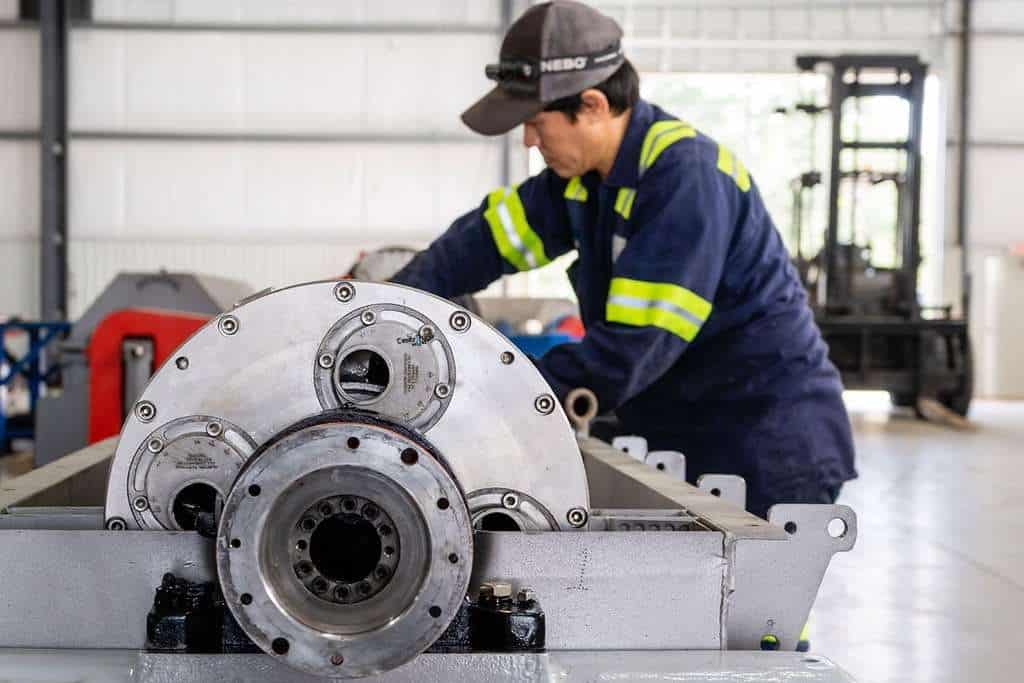
The centerpiece of the process is a non-destructive teardown and inspection, or NDTI. Non-destructive means we disassemble and evaluate the machine without cutting into or damaging serviceable components, so nothing is compromised while we assess it.
Getting the machine to the shop
When you schedule an inspection, we can dispatch a truck to your facility and transport the centrifuge to our shop. Our service centers in Houston, Texas and the Chicago, Illinois area are equipped to handle machines of many types and sizes, from decanters to disc-stack, basket, and pusher/peeler centrifuges across more than 45 OEM brands.
Working in a controlled shop environment, rather than in the field, lets our engineers fully open the machine, use proper tooling and measurement equipment, and evaluate every component accurately.
The teardown and evaluation
During the non-destructive teardown, our engineers disassemble the rotating assembly and examine each major component. They check bearings and seals for wear, inspect the bowl and conveyor for erosion, chemical attack, and mechanical damage, look for cracks or weld areas that need repair, and evaluate the gearbox and drivetrain.
Measurements and observations are recorded as they go. The aim is to distinguish what is still serviceable, what can be reconditioned, and what must be replaced, so the resulting scope is neither padded nor cut short.
The documented condition report
When the evaluation is complete, you receive a detailed written condition report. It describes the state of the machine, lists the recommended repairs, and specifies the parts required to complete them. This report is the deliverable that turns an inspection into a decision-making tool.
With that document in hand, you can weigh repair against replacement with real information, plan a shutdown around a known scope, and avoid the surprise change orders that come from quoting a machine sight unseen.
From findings to quote to rebuild
The condition report is paired with a quote so you know the scope and the cost before committing. No repair work proceeds until you approve it. Once you do, our engineers carry out the rebuild: repairing weld areas, refitting wear parts such as o-rings and gaskets, replacing worn components, performing any approved upgrades, and balancing the rotating assembly statically and dynamically.
If the job needs a hard-to-find or long-lead part, we can reverse-engineer and fabricate it in-house to keep your machine moving. Before it ships back, we complete a full test run to confirm the centrifuge is returning to service at peak performance.
Schedule your centrifuge inspection
An inspection is the fastest way to get an accurate answer about your machine's condition and the cost to restore it. It is the first step in every quality repair and the only honest basis for a firm quote.
Learn more about our centrifuge inspection, centrifuge rebuild, and decanter centrifuge repair services, or request a quote to get started. If your machine is already down and cannot wait, our 24/7 emergency line is 832-338-4990.